
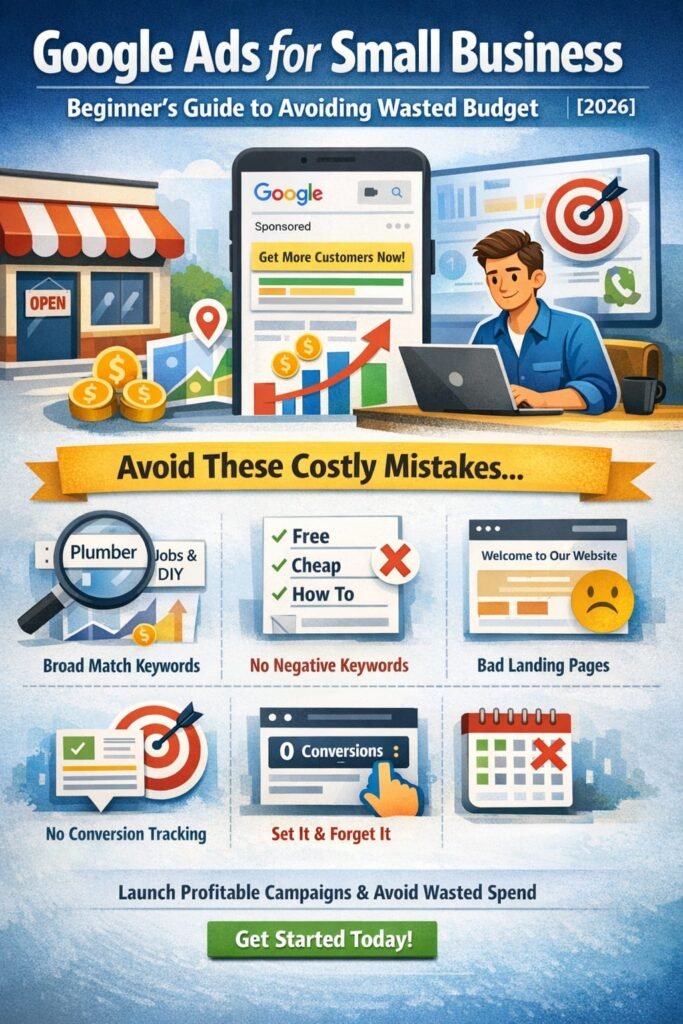
Google Ads for small business can be the fastest path to new customers, or the fastest way to waste money. The difference comes down to setup, targeting, and ongoing management. Most small businesses that try Google Ads and fail make the same 5 mistakes that are entirely preventable.
This guide walks you through everything you need to know about Google Ads for small business, from setup to optimization, so your first campaign generates leads instead of draining your bank account.
How Google Ads Works for Small Businesses
Google Ads places your business at the top of search results when someone searches for your service. You pay only when someone clicks your ad. The amount you pay per click depends on competition, keyword quality, and your ad relevance.
For a local plumber, that means appearing at the top when someone in your city searches “emergency plumber near me.” For a restaurant, it means showing up for “best Italian food Bay Area.” You choose the keywords, the geographic area, and your daily budget.
The beauty of Google Ads for small business is precision. Unlike billboards or print ads, you reach people actively searching for what you offer at the exact moment they need it.
Mistake 1: Using Broad Match Keywords
The single most expensive Google Ads for small business mistake is using broad match keywords. If you bid on “plumber” with broad match, Google shows your ad for searches like “how to become a plumber,” “plumber salary,” and “plumber’s putty.” None of these searchers want to hire you.
Use phrase match or exact match keywords instead. Phrase match (keywords in quotes) shows your ad when the search includes your phrase. Exact match (keywords in brackets) shows your ad only for that specific search.
Start with exact match for your highest-intent keywords, then expand to phrase match once you have conversion data. This alone can reduce wasted spend by 40 to 60%.
Mistake 2: Not Using Negative Keywords
Negative keywords tell Google what searches should NOT trigger your ad. Without them, your Google Ads for small business budget bleeds on irrelevant clicks.
Every campaign should include negative keywords like: free, jobs, hiring, salary, DIY, how to become, training, certification, review, and cheap (unless you specifically target budget-conscious customers).
Review your Search Terms report weekly and add new negative keywords for any irrelevant searches that triggered your ads. This is ongoing maintenance that prevents budget waste.
Mistake 3: Sending Traffic to Your Homepage
Your homepage serves everyone. Your ads target specific searchers with specific intent. Sending ad clicks to your homepage forces visitors to figure out where to go next. Most won’t bother.
Create dedicated landing pages for each ad group. If you’re running Google Ads for small business targeting “emergency plumber Sunnyvale,” the landing page should be about emergency plumbing in Sunnyvale with a click-to-call button and a simple form. Nothing else.
Dedicated landing pages typically convert 2 to 5x better than homepages. The investment in creating them pays for itself within the first week of running ads.
Mistake 4: No Conversion Tracking
Running Google Ads for small business without conversion tracking is like running a business without a cash register. You know money is going out but have no idea what’s coming back.
Set up conversion tracking for every valuable action: phone calls from ads, form submissions, chat messages, and direction requests. Google Ads provides free call tracking for calls made directly from ads.
Without conversion tracking, you cannot know which keywords generate leads and which waste money. You’re optimizing blind, and every dollar you can’t attribute is potentially a dollar wasted.
Our paid ads management service includes comprehensive conversion tracking setup as a foundational step.
Mistake 5: Set It and Forget It
The most common Google Ads for small business mistake is launching a campaign and never touching it again. Google Ads require weekly optimization to perform well.
Every week, review your Search Terms report, adjust bids, pause underperforming keywords, test new ad copy, and check your quality scores. Campaigns that receive weekly attention consistently outperform those left on autopilot.
If you don’t have time for weekly optimization, either use Google’s automated bidding strategies (Target CPA or Maximize Conversions) or hire someone to manage your campaigns. Unmanaged campaigns almost always waste 30 to 50% of their budget.
How Much Should Small Businesses Spend on Google Ads?
For Bay Area local businesses, we recommend starting with $1,000 per month in ad spend. This provides enough data to optimize effectively while generating meaningful leads.
The ideal budget depends on your industry’s cost per click. For service businesses (plumbers, dentists, lawyers), expect $5 to $25 per click. For restaurants and retail, $1 to $5 per click. Calculate your budget based on how many leads you need: if leads cost $20 each and you want 50 leads per month, budget $1,000.
Start conservative, track everything, and scale what works. A well-managed Google Ads for small business campaign should generate $3 to $8 in revenue for every $1 spent. If yours doesn’t, something in the setup needs fixing. Read our comparison of SEO vs paid ads to understand how both channels work together.
Get a free ad account audit and we will identify exactly where your budget is being wasted.
Frequently Asked Questions
Are Google Ads worth it for small businesses?
Yes, when set up and managed correctly. Google Ads for small business delivers the fastest path to new customers. The key is proper keyword targeting, conversion tracking, and ongoing optimization.
How quickly will I see results from Google Ads?
You can see clicks and traffic on day one. Meaningful optimization data takes 2 to 4 weeks. Most campaigns reach optimal performance within 60 days of launch.
Should I run Google Ads or focus on SEO?
Both, ideally. Google Ads delivers immediate results while SEO builds long-term organic traffic. Use ad data to identify which keywords convert, then target those keywords organically.
Can I run Google Ads myself or do I need an agency?
You can run basic campaigns yourself using this guide. However, campaigns managed by experienced professionals typically generate 2 to 3x better ROI due to advanced optimization techniques and ongoing management.